Wednesday, April 26, 2023

The Nevada desert


 The Nevada desert is a large, arid region located in the western United States. It covers much of the state of Nevada, as well as parts of California, Utah, and Idaho. The desert is known for its hot, dry climate, with temperatures often reaching over 100 degrees Fahrenheit during the day and dropping to freezing at night.

The Nevada desert is also home to a number of unique plants and animals, many of which have adapted to the harsh conditions of the environment. Some of the most notable species include desert bighorn sheep, coyotes, rattlesnakes, and various types of cacti and other succulent plants.

The area is also famous for its stunning natural landmarks, including the iconic rock formations of Red Rock Canyon, the otherworldly landscapes of the Valley of Fire, and the vast, shimmering expanse of the Bonneville Salt Flats. Additionally, the Nevada desert is home to a number of important military facilities, including Area 51, a secretive air base that has long been the subject of conspiracy theories and speculation.

Area 51


Area 51 is a highly classified United States Air Force facility located in the Nevada desert, about 83 miles north-northwest of Las Vegas. It is known for its association with rumors and conspiracy theories about extraterrestrial life and advanced technologies.The facility was established in the 1950s as a testing and development site for experimental aircraft and weapons systems, including the U-2 spy plane and the F-117 Nighthawk stealth fighter. The strict secrecy surrounding the base, combined with the unusual aircraft and experimental technologies being tested there, have fueled rumors and speculation about secret government programs involving UFOs and alien technology.Despite the many conspiracy theories, the U.S. government has consistently maintained that Area 51 is simply a testing and training site for military personnel and that there is no evidence of extraterrestrial activity or technology being housed there. However, the facility remains highly classified, and the true nature of its operations is still not fully known.


Folk

 "Folk" can have a few different meanings depending on the context in which it is used. Here are a few possible interpretations:


  1. Folk can refer to traditional, indigenous, or rural cultures, especially those with a strong oral tradition. For example, "folk music" often refers to music that is passed down through generations and reflects the cultural heritage of a particular group or region.

  2. Folk can also refer to a group of people who share a common culture or identity, often with a sense of shared history or traditions. For example, "the Scottish folk" might refer to people of Scottish descent who have a shared cultural heritage.

  3. Folk can be used to describe something that is simple, rustic, or unrefined. For example, "a folk remedy" might refer to a homemade or traditional cure for an ailment, as opposed to a pharmaceutical medication.

  4. Folk can be used as a shortened form of "folks," a colloquial term for people in general. For example, "I was chatting with some folk at the pub last night" would mean "I was talking to some people at the pub last night."

  5. "Folk" generally refers to traditional or popular culture, particularly in music and storytelling. Folk music is often characterized by its simplicity, acoustic instrumentation, and emphasis on storytelling and community. Folk stories, or folklore, can include myths, legends, and traditional tales passed down through generations. The term "folk" can also refer more broadly to a particular cultural group or community.

  6. Overall, the term "folk" is often used to describe things that are traditional, simple, and connected to a particular culture or community.

Tuesday, April 25, 2023

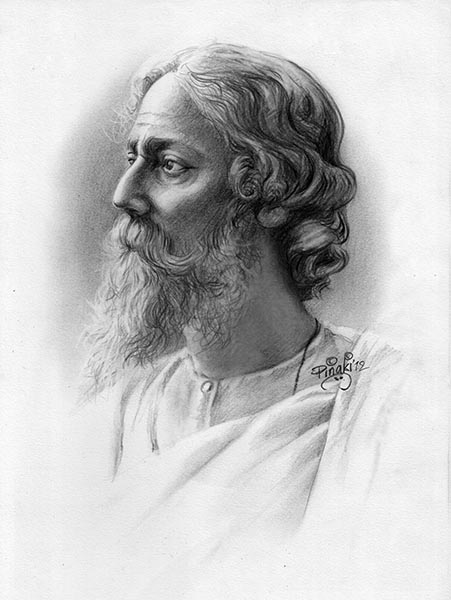
Rabindranath Tagore


Rabindranath Tagore (1861-1941) was a Bengali polymath, writer, poet, composer, philosopher, social reformer, and painter who is best known for his contributions to literature and music. He was the first non-European to win the Nobel Prize in Literature in 1913, for his collection of poems titled "Gitanjali". He is also widely regarded as the national poet of India and Bangladesh.

Tagore was born in Calcutta (now Kolkata), India, on May 7, 1861, into a prominent Bengali family. He was the youngest of 13 children, and his father, Debendranath Tagore, was a leader of the Brahmo Samaj, a reformist Hindu sect. Tagore was homeschooled and began writing poetry at a young age.

In 1878, Tagore traveled to England to study law, but he left after a few months to focus on his writing. He returned to India in 1880 and began publishing his poetry and prose in Bengali literary magazines. He quickly gained a reputation as a talented writer and soon became a prominent figure in the Bengali literary scene.

Tagore's most famous work, "Gitanjali" (Song Offerings), was published in 1910 and consists of 103 poems. It was translated into English by Tagore himself and was well-received in both India and the West. The book's popularity led to Tagore being awarded the Nobel Prize in Literature in 1913.

Tagore was also a social reformer who worked to improve the lives of the poor and oppressed in India. He was involved in the Indian independence movement and was a vocal critic of British colonial rule. He founded a school called Santiniketan, which became a center for art, literature, and social reform.

Tagore was a prolific writer who authored over 2,000 poems, several novels, and numerous essays and short stories. He was also an accomplished musician who wrote over 2,000 songs, many of which are still popular in India and Bangladesh today.

Tagore died on August 7, 1941, in Calcutta, India, at the age of 80. His legacy lives on through his writing and his contributions to Indian literature and culture.

Harry Potter


Harry Potter series consists of seven books, each detailing a different stage in Harry Potter's life as he navigates the wizarding world and faces the threat of the evil Lord Voldemort.

Book 1: Harry Potter and the Philosopher's Stone The series begins with Harry Potter living in the cupboard under the stairs of his abusive aunt and uncle's house. On his eleventh birthday, he receives a letter inviting him to attend Hogwarts School of Witchcraft and Wizardry, and he begins to learn about his magical heritage. Harry discovers that his parents were killed by the dark wizard Lord Voldemort, who also tried to kill him as a baby but failed, leaving Harry with a lightning-bolt-shaped scar on his forehead. With the help of his new friends Ron Weasley and Hermione Granger, Harry uncovers the mystery of the Philosopher's Stone, an object that can grant immortality.


Book 2: Harry Potter and the Chamber of Secrets In his second year at Hogwarts, Harry encounters the malevolent spirit of Salazar Slytherin, the founder of the Slytherin House, who has opened the Chamber of Secrets, unleashing a monster that petrifies students. Harry, Ron, and Hermione work together to uncover the truth and save Hogwarts.

Book 3: Harry Potter and the Prisoner of Azkaban In his third year at Hogwarts, Harry encounters Sirius Black, a notorious prisoner who has escaped from the wizarding prison, Azkaban. Harry learns the truth about his godfather and his parents' past while facing the dangerous Dementors, dark creatures that feed on happy memories.

Book 4: Harry Potter and the Goblet of Fire Harry competes in the Triwizard Tournament, a dangerous competition between Hogwarts and two other wizarding schools. However, Voldemort's return becomes apparent, and Harry must face his fears and confront the dark wizard.

Book 5: Harry Potter and the Order of Phoenix In his fifth year at Hogwarts, Harry is shunned by the wizarding community and faces many challenges, including a new Defense Against the Dark Arts teacher and a secret organization, the Order of the Phoenix, dedicated to fighting Voldemort.

Book 6: Harry Potter and the Half-Blood Prince As Voldemort and his Death Eaters become more powerful, Dumbledore trains Harry to face the dark wizard in a final confrontation. Harry learns more about Voldemort's past and discovers a crucial piece of information that could help defeat him.

Book 7: Harry Potter and the Deathly Hallows In the final book of the series, Harry, Ron, and Hermione set out on a dangerous mission to find and destroy the Horcruxes, objects containing a piece of Voldemort's soul that give him immortality. The trio faces numerous obstacles and sacrifices as they prepare for the final battle against Voldemort and his followers.

The series concludes with the ultimate showdown between Harry and Voldemort, leading to a stunning conclusion and a hopeful future for the wizarding world.

Monday, April 24, 2023

Bank plc

 "Bank plc" is a common way to refer to a bank that is organized as a public limited company (plc). In the United Kingdom, many banks and other financial institutions are organized as public limited companies, which means they are legally required to have at least £50,000 of share capital and their shares can be traded on a public stock exchange. Banks that are organized as plcs may have shareholders who own a portion of the bank and may receive dividends based on the bank's profits. Examples of banks in the UK that are organized as plcs include Barclays plc, Lloyds Banking Group plc, and HSBC Holdings plc.

World War II

 World War II, was a global conflict that lasted from 1939 to 1945. It was fought primarily between two alliances: the Allies, composed of the United States, the United Kingdom, the Soviet Union, and other countries, and the Axis powers, composed of Germany, Japan, and Italy, and other countries.

The war began on September 1, 1939, when Germany invaded Poland. This led to declarations of war by the United Kingdom and France, and eventually the other Allied powers. The war quickly spread, with Germany conquering much of Europe, Japan expanding its empire in Asia, and Italy occupying parts of Africa.

The turning point of the war came in 1941 when Japan attacked the United States at Pearl Harbor, leading to the US entering the war. The Allies began to push back against the Axis powers, with major battles in Europe, Africa, and the Pacific.

The war ended on September 2, 1945, when Japan surrendered after the atomic bombings of Hiroshima and Nagasaki by the United States. The war resulted in an estimated 70 million casualties, making it one of the deadliest conflicts in human history. Its impact on the world was profound, leading to the formation of the United Nations and the beginning of the Cold War.

Harry Potter

 The Dark Lord Ascending T he two men appeared out of nowhere, a few yards apart in the narrow, moonlit lane. For a second they stood quite ...