Tuesday, April 25, 2023

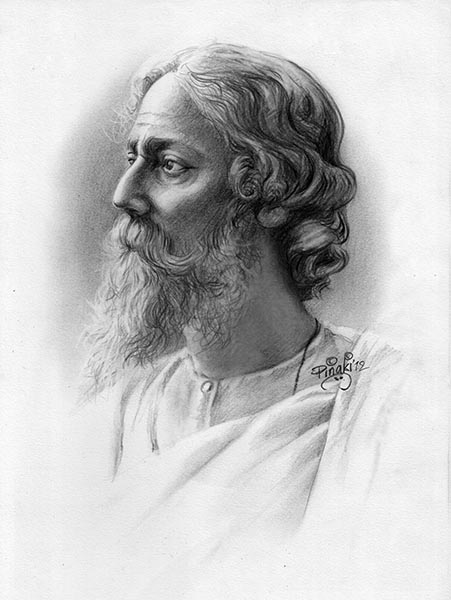
Rabindranath Tagore


Rabindranath Tagore (1861-1941) was a Bengali polymath, writer, poet, composer, philosopher, social reformer, and painter who is best known for his contributions to literature and music. He was the first non-European to win the Nobel Prize in Literature in 1913, for his collection of poems titled "Gitanjali". He is also widely regarded as the national poet of India and Bangladesh.

Tagore was born in Calcutta (now Kolkata), India, on May 7, 1861, into a prominent Bengali family. He was the youngest of 13 children, and his father, Debendranath Tagore, was a leader of the Brahmo Samaj, a reformist Hindu sect. Tagore was homeschooled and began writing poetry at a young age.

In 1878, Tagore traveled to England to study law, but he left after a few months to focus on his writing. He returned to India in 1880 and began publishing his poetry and prose in Bengali literary magazines. He quickly gained a reputation as a talented writer and soon became a prominent figure in the Bengali literary scene.

Tagore's most famous work, "Gitanjali" (Song Offerings), was published in 1910 and consists of 103 poems. It was translated into English by Tagore himself and was well-received in both India and the West. The book's popularity led to Tagore being awarded the Nobel Prize in Literature in 1913.

Tagore was also a social reformer who worked to improve the lives of the poor and oppressed in India. He was involved in the Indian independence movement and was a vocal critic of British colonial rule. He founded a school called Santiniketan, which became a center for art, literature, and social reform.

Tagore was a prolific writer who authored over 2,000 poems, several novels, and numerous essays and short stories. He was also an accomplished musician who wrote over 2,000 songs, many of which are still popular in India and Bangladesh today.

Tagore died on August 7, 1941, in Calcutta, India, at the age of 80. His legacy lives on through his writing and his contributions to Indian literature and culture.

Harry Potter


Harry Potter series consists of seven books, each detailing a different stage in Harry Potter's life as he navigates the wizarding world and faces the threat of the evil Lord Voldemort.

Book 1: Harry Potter and the Philosopher's Stone The series begins with Harry Potter living in the cupboard under the stairs of his abusive aunt and uncle's house. On his eleventh birthday, he receives a letter inviting him to attend Hogwarts School of Witchcraft and Wizardry, and he begins to learn about his magical heritage. Harry discovers that his parents were killed by the dark wizard Lord Voldemort, who also tried to kill him as a baby but failed, leaving Harry with a lightning-bolt-shaped scar on his forehead. With the help of his new friends Ron Weasley and Hermione Granger, Harry uncovers the mystery of the Philosopher's Stone, an object that can grant immortality.


Book 2: Harry Potter and the Chamber of Secrets In his second year at Hogwarts, Harry encounters the malevolent spirit of Salazar Slytherin, the founder of the Slytherin House, who has opened the Chamber of Secrets, unleashing a monster that petrifies students. Harry, Ron, and Hermione work together to uncover the truth and save Hogwarts.

Book 3: Harry Potter and the Prisoner of Azkaban In his third year at Hogwarts, Harry encounters Sirius Black, a notorious prisoner who has escaped from the wizarding prison, Azkaban. Harry learns the truth about his godfather and his parents' past while facing the dangerous Dementors, dark creatures that feed on happy memories.

Book 4: Harry Potter and the Goblet of Fire Harry competes in the Triwizard Tournament, a dangerous competition between Hogwarts and two other wizarding schools. However, Voldemort's return becomes apparent, and Harry must face his fears and confront the dark wizard.

Book 5: Harry Potter and the Order of Phoenix In his fifth year at Hogwarts, Harry is shunned by the wizarding community and faces many challenges, including a new Defense Against the Dark Arts teacher and a secret organization, the Order of the Phoenix, dedicated to fighting Voldemort.

Book 6: Harry Potter and the Half-Blood Prince As Voldemort and his Death Eaters become more powerful, Dumbledore trains Harry to face the dark wizard in a final confrontation. Harry learns more about Voldemort's past and discovers a crucial piece of information that could help defeat him.

Book 7: Harry Potter and the Deathly Hallows In the final book of the series, Harry, Ron, and Hermione set out on a dangerous mission to find and destroy the Horcruxes, objects containing a piece of Voldemort's soul that give him immortality. The trio faces numerous obstacles and sacrifices as they prepare for the final battle against Voldemort and his followers.

The series concludes with the ultimate showdown between Harry and Voldemort, leading to a stunning conclusion and a hopeful future for the wizarding world.

Monday, April 24, 2023

Bank plc

 "Bank plc" is a common way to refer to a bank that is organized as a public limited company (plc). In the United Kingdom, many banks and other financial institutions are organized as public limited companies, which means they are legally required to have at least £50,000 of share capital and their shares can be traded on a public stock exchange. Banks that are organized as plcs may have shareholders who own a portion of the bank and may receive dividends based on the bank's profits. Examples of banks in the UK that are organized as plcs include Barclays plc, Lloyds Banking Group plc, and HSBC Holdings plc.

World War II

 World War II, was a global conflict that lasted from 1939 to 1945. It was fought primarily between two alliances: the Allies, composed of the United States, the United Kingdom, the Soviet Union, and other countries, and the Axis powers, composed of Germany, Japan, and Italy, and other countries.

The war began on September 1, 1939, when Germany invaded Poland. This led to declarations of war by the United Kingdom and France, and eventually the other Allied powers. The war quickly spread, with Germany conquering much of Europe, Japan expanding its empire in Asia, and Italy occupying parts of Africa.

The turning point of the war came in 1941 when Japan attacked the United States at Pearl Harbor, leading to the US entering the war. The Allies began to push back against the Axis powers, with major battles in Europe, Africa, and the Pacific.

The war ended on September 2, 1945, when Japan surrendered after the atomic bombings of Hiroshima and Nagasaki by the United States. The war resulted in an estimated 70 million casualties, making it one of the deadliest conflicts in human history. Its impact on the world was profound, leading to the formation of the United Nations and the beginning of the Cold War.

The Ice Age

 The Ice Age is a geological period characterized by a long-term reduction in global temperatures, resulting in the expansion of ice sheets and glaciers over vast areas of the Earth's surface. There have been several ice ages throughout the Earth's history, with the most recent one occurring during the Pleistocene epoch, approximately 2.6 million to 11,700 years ago.

During the last ice age, large parts of North America, Europe, and Asia were covered in ice sheets that were several kilometers thick. The ice sheets also caused sea levels to drop, exposing land bridges that allowed humans and animals to migrate between continents.

The causes of ice ages are complex and involve a combination of factors, including changes in the Earth's orbit, variations in solar radiation, and changes in atmospheric concentrations of greenhouse gases. The current consensus among scientists is that human activities, particularly the burning of fossil fuels, are contributing to a rapid warming of the planet and are likely to disrupt the Earth's climate in ways that could have serious consequences for human societies and ecosystems.

The Holocene Epoch

 The Holocene Epoch is the current geological epoch and is the second and last epoch of the Quaternary Period, which began about 11,700 years ago after the last major ice age. It is characterized by a relatively stable and warm climate, which allowed for the development and expansion of human civilization.

During the Holocene epoch, the Earth's climate has gone through a series of minor fluctuations, but it has remained relatively warm and stable compared to the preceding glacial periods. This allowed for the development of agriculture and the growth of human populations, leading to significant changes in the Earth's ecosystems, including deforestation, habitat destruction, and the extinction of many species.

The Holocene epoch is divided into three phases: the Preboreal, Boreal, and Atlantic. The Preboreal period, which lasted from about 11,700 to 10,000 years ago, saw the warming of the Earth's climate and the retreat of glaciers. The Boreal period, which lasted from about 10,000 to 8,000 years ago, saw the expansion of forests and the development of peatlands. The Atlantic period, which lasted from about 8,000 to 4,500 years ago, saw the warmest and wettest conditions of the Holocene epoch, which led to the development of grasslands and the expansion of human civilization.

Today, the Holocene epoch is characterized by significant impacts of human activities on the environment, including climate change, deforestation, pollution, and species extinctions. As a result, there are growing efforts to mitigate these impacts and transition towards more sustainable and equitable systems of development.

The Quaternary Period

 The Quaternary Period is the current period of the Cenozoic Era, which began about 2.6 million years ago and continues to the present day. It is characterized by a series of ice ages and interglacial periods, as well as the emergence and evolution of modern humans.

The Quaternary Period is divided into two epochs: the Pleistocene and the Holocene. The Pleistocene epoch, which lasted from about 2.6 million to 11,700 years ago, saw the development of large ice sheets in the northern hemisphere, leading to lower sea levels and changes in climate and vegetation. During this time, many large mammals, such as mammoths, sabre-toothed cats, and giant ground sloths, became extinct, possibly as a result of hunting by early humans or changes in climate.

The Holocene epoch, which began about 11,700 years ago and continues to the present day, is characterized by warmer and more stable climate conditions, which allowed for the development of agriculture and the growth of human populations. During this time, humans developed complex societies and civilizations, leading to significant impacts on the environment and the extinction of many species.

Today, the Quaternary Period is characterized by ongoing climate change, with global temperatures and sea levels rising as a result of human activities such as burning fossil fuels and deforestation. This is leading to significant impacts on ecosystems and the planet as a whole, and efforts are being made to mitigate these impacts and adapt to the changing climate.

Harry Potter

 The Dark Lord Ascending T he two men appeared out of nowhere, a few yards apart in the narrow, moonlit lane. For a second they stood quite ...